
Smart Charging by Chargekeeper
Smart Charging optimizes the distribution of available power across multiple chargers within the same zone, while respecting the constraints of the electrical infrastructure.
How it works
Smart Charging is enabled at the zone level.
It is therefore essential that the electrical configuration of the zone meter be accurate and reliable.
The following parameters must in particular be correctly entered:
- maximum power of the delivery point,
- voltage,
- number of phases.
An incorrect meter configuration can lead to improper power management.
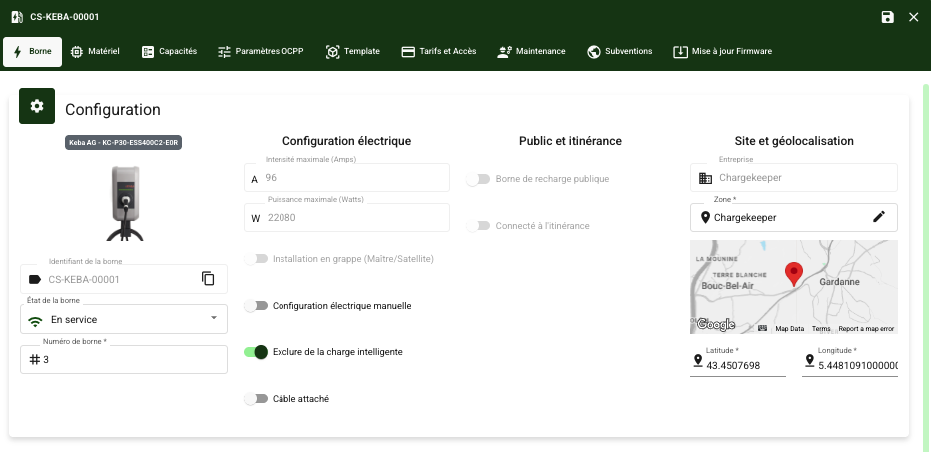
Charger exclusion
It is possible to exclude certain chargers associated with a zone from Smart Charging.
These chargers:
- are not driven by charging plans,
- operate autonomously,
- still continue to report their data to the supervision system.
Triggering and updating of charging plans
The charging plans define the maximum power allocated to each charging point.
They are recalculated automatically:
- upon receipt of an OCPP StartTransaction,
- upon receipt of an OCPP StopTransaction,
- every 5 minutes, in order to adjust the distribution in real time.
Once calculated, the charging plans are transmitted to the chargers via the OCPP protocol.
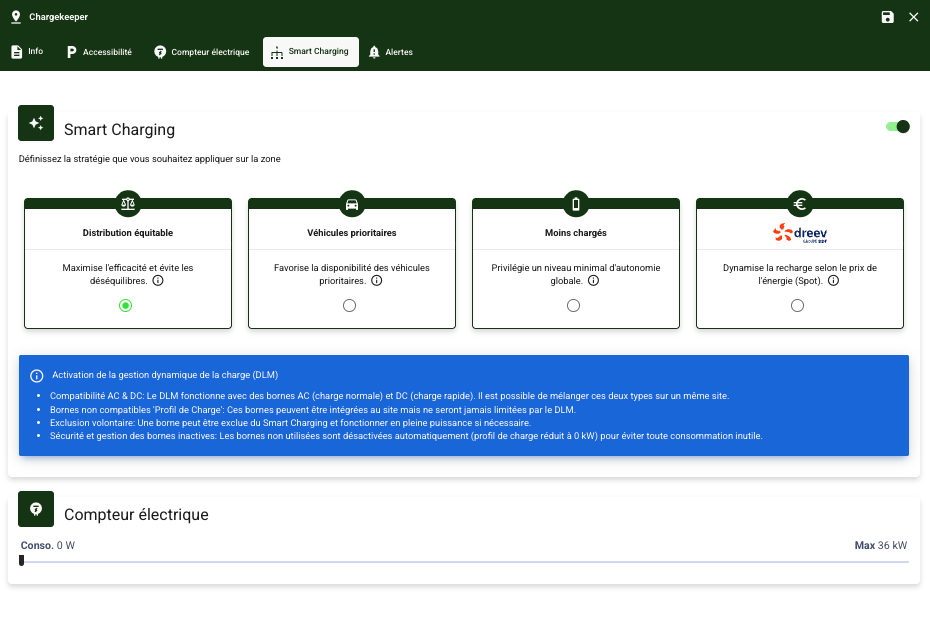
Available Smart Charging strategies
Chargekeeper offers several power distribution strategies, to be adapted to your objectives.
Fair power distribution
The available power is distributed fairly across all active charging sessions.
- Each vehicle receives the same share of power
- Simple and balanced
- Suited to multi-user car parks.
Prioritization by vehicle
Certain vehicles can be defined as priority (low, medium, high).
- Priority vehicles receive more power first
- The other vehicles are charged according to the remaining power.
- Ideal for fleets or critical uses.
👉 To learn more about prioritization by vehicle, see the dedicated article: Smart Charging - Prioritization by vehicle.
Prioritization of the least-charged vehicles
Power is allocated first to the vehicles with the lowest battery level.
- Optimizes the overall range of the fleet
- Reduces situations where vehicles are insufficiently charged
- Particularly suited to fleets and fast-rotation sites
